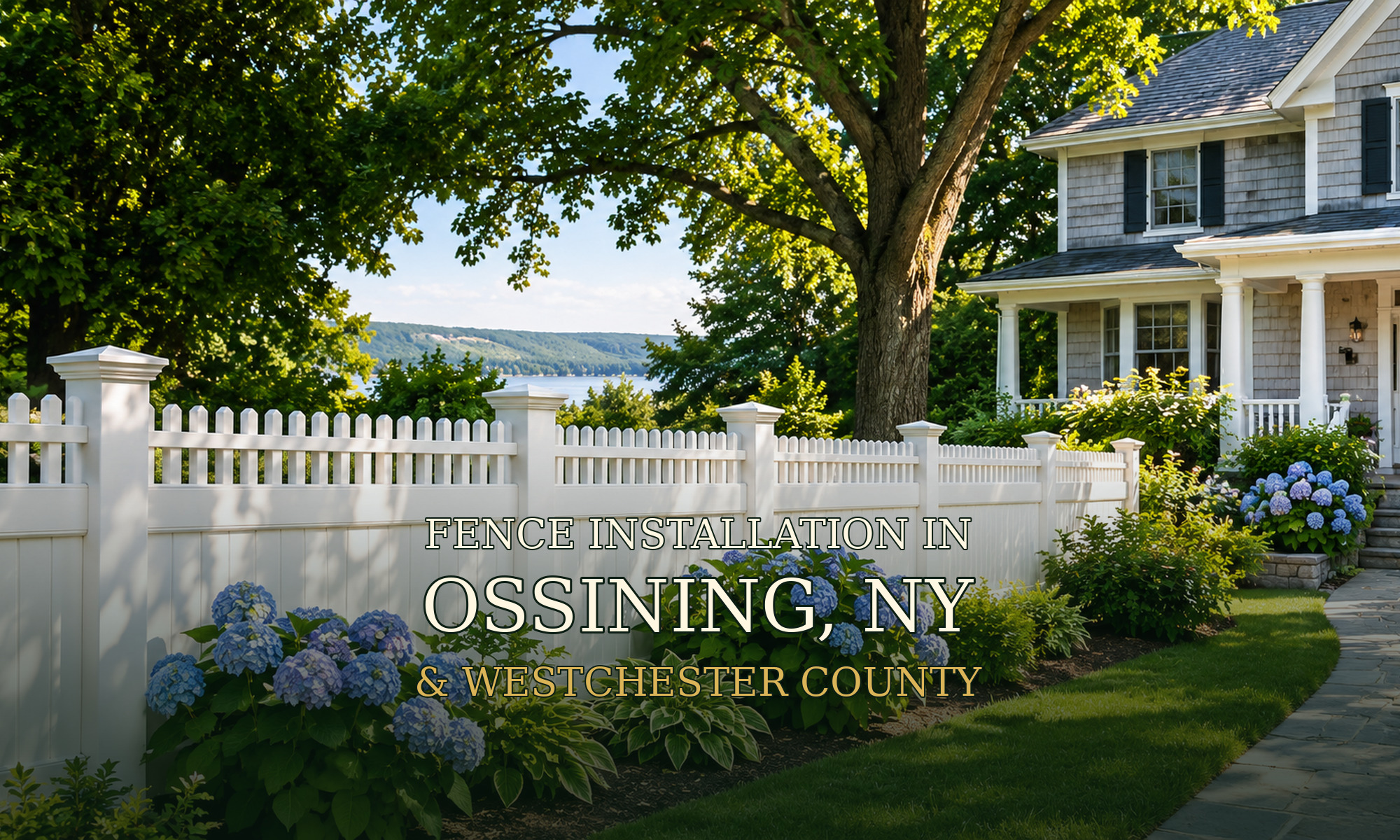

A practical guide to fencing uneven terrain, comparing materials, protecting landscaping, and understanding local requirements in Ossining, New York.
Fence installation on sloped yards in Ossining requires careful planning to achieve a result that looks attractive, performs reliably, and complements the surrounding landscape. Unlike a relatively level property, a hillside yard can present challenges involving fence alignment, ground clearance, drainage, post placement, and gate operation.
For homeowners in Ossining, New York, these considerations are particularly relevant. The community’s rolling terrain, wooded properties, established neighborhoods, and proximity to the Hudson River mean that different sections of the same yard can have very different elevations.
A fence that works beautifully on flat ground may need a different configuration when installed along a hillside, beside a retaining wall, or across a yard with uneven grades.
The good news is that many sloped properties can accommodate attractive wood, vinyl, aluminum, and other fencing systems. The key is understanding which installation approach best suits the material, the terrain, and the purpose of the fence.
This guide explains what Ossining homeowners should know before planning a fence on uneven ground.
Why Sloped Yard Fencing Is Different in Ossining, NY
Ossining’s terrain is one of the characteristics that distinguishes it from many other Westchester County communities.
The landscape includes hillsides, changes in elevation, mature trees, wooded areas, and properties with scenic outlooks toward the Hudson River.
For fence installation, these conditions matter because the ground beneath the fence is not always consistent.
A relatively short fence line might cross several different elevations. One section of a property may be level, while another slopes toward a driveway, garden, or neighboring lot.
These differences influence how fence posts, panels, and gates should be planned.
Common Challenges on Sloping Properties
Uneven ground clearance: Fence sections may create gaps beneath them when the terrain changes.
Panel alignment: Standard rectangular fence panels may not follow the slope naturally.
Gate operation: Gates require appropriate clearance and may be difficult to operate where the ground changes elevation.
Post support: Soil conditions and potential erosion can affect installation requirements.
Drainage: Surface water may travel downhill along or across the proposed fence line.
Landscape preservation: Trees, shrubs, retaining walls, and planted areas can limit suitable post locations.
Understanding these factors before selecting a fence material can prevent unnecessary changes later in the project.
Stepped vs. Racked Fencing: Which Works Better on a Hill?
One of the most important decisions when installing a fence on a slope is how the fence sections will follow the ground.
Two common approaches are stepped fencing and racked, or terrain-following, fencing.
They produce different appearances and are not equally suitable for every material or property.
Stepped Fence Installation
A stepped fence uses panels installed horizontally at different elevations.
Instead of following the exact slope of the ground, each panel remains level, creating a staircase-like arrangement along the fence line.
Advantages of stepped fencing:
- Can accommodate noticeable changes in elevation.
- Maintains a level top line for each individual panel.
- Can work with certain prefabricated panel systems.
- May complement properties where a structured, architectural appearance is desirable.
Potential disadvantages:
- Gaps can develop beneath panels on steeper sections.
- The stepped appearance may not suit every landscape.
- Additional planning may be necessary for pet containment and privacy.
A stepped fence may be a practical choice where the ground changes elevation significantly, but homeowners should understand how the spaces beneath the panels will be handled.
Racked or Terrain-Following Fence Installation
Racked fencing uses panels or components configured to follow the grade more closely.
Rather than keeping every section perfectly horizontal, the fence follows the direction of the terrain.
Advantages of racked fencing:
- Can create a more continuous appearance along a slope.
- May reduce certain gaps beneath the fence.
- Can follow gradual changes in elevation more naturally.
Potential disadvantages:
- Not every panel or fencing material supports substantial racking.
- Steeper grades may exceed the manufacturer’s limits.
- The finished appearance depends on the fence style and site conditions.
Some ornamental aluminum and other fence systems offer panels designed to accommodate changes in grade.
However, the allowable slope varies between products.
Which Method Should You Choose?
The answer depends on the severity of the slope, the selected fence material, the desired appearance, and the fence’s intended purpose.
A decorative boundary may have different requirements from a privacy fence or an enclosure intended to contain a dog.
Before choosing between stepped and racked fencing, homeowners should understand the ground clearance, appearance, and material limitations associated with each option.
Choosing the Best Fence Material for a Sloped Ossining Yard
Material selection affects the installation method, maintenance requirements, appearance, and long-term performance of a fence.
No single material is automatically the best for every hillside property.
Wood Fencing on Sloped Ground
Wood fencing offers considerable flexibility in design.
It can complement Ossining’s traditional homes, mature landscaping, and wooded residential properties.
Custom wood fencing can sometimes be built to accommodate irregular grade changes more closely than standardized panels.
Popular styles include vertical-board privacy fencing, decorative picket fencing, and selected horizontal-board designs.
However, homeowners should consider:
- How the fence will follow changes in elevation.
- Whether gaps beneath the sections are acceptable.
- Where gates can operate conveniently.
- The effects of moisture and vegetation.
- Long-term maintenance and refinishing.
Wood fencing can be an attractive choice when natural character and design flexibility are priorities.
Vinyl Fencing on Uneven Terrain
Vinyl fencing provides a clean appearance and relatively low routine surface maintenance.
It is often considered for backyard privacy, family yards, and residential property boundaries.
However, not every vinyl system is designed to accommodate significant slopes.
Some systems may require stepped installation, while other products offer limited terrain-following flexibility.
Panel dimensions, post spacing, ground clearance, and reinforcement should all be considered.
For a steep yard, the exact vinyl fencing product matters as much as the general material category.
Ornamental Aluminum Fencing on Hillsides
Ornamental aluminum can be appealing where homeowners want a decorative boundary while preserving views of the landscape.
Certain aluminum fence systems are manufactured with racking capability, making them useful for some sloping properties.
Their open-picket appearance can complement gardens, landscaped walkways, and properties with scenic outlooks.
However, homeowners should confirm how much grade variation the selected product can accommodate.
An open fence also provides less visual privacy than solid wood or vinyl.
Chain-Link Fencing on Slopes
Chain-link fencing can offer a functional approach to enclosing irregular terrain.
Depending on the installation and site conditions, the fence fabric and framing can accommodate some changes in grade.
It may be considered for pet enclosures, utility spaces, and selected property boundaries.
For steep or irregular terrain, tensioning, ground clearance, gate placement, and terminal-post support deserve particular attention.
How to Plan Privacy Fencing on a Hillside
Privacy is one of the most common reasons homeowners consider installing a fence.
On a hillside, however, privacy can be more complicated than simply choosing a taller panel.
The relationship between neighboring properties matters.
A fence that provides effective screening on level ground may offer less privacy when an adjacent home is positioned higher on the slope.
Similarly, a solid fence placed near the top of a hillside may block an attractive view from another part of the property.
Consider Elevation Differences
Before selecting a privacy fence, identify where neighboring windows, patios, decks, or other outdoor areas are located.
The line of sight from those locations may influence where screening is most useful.
Consider Privacy from Multiple Viewpoints
A property may need screening around a patio but benefit from more open fencing elsewhere.
Using different fence styles in different locations can sometimes create a better balance.
Keep Municipal Height Limits in Mind
A fence should not be designed solely around the height needed for privacy without first checking the applicable municipal requirements.
This is particularly important where grade changes affect how fence height is measured.
For fence installation on sloped yards in Ossining, effective privacy depends on placement and elevation as much as fence material.
Retaining Walls, Stonework, and Fence Placement
Many hillside properties include retaining walls, terraces, or existing stonework.
These features may appear to offer convenient locations for new fencing, but they require careful evaluation.
A retaining wall designed to support soil is not necessarily designed to carry additional fence loads.
Wind acting on a solid fence can transfer force through the posts into the supporting structure.
Installing a fence directly on a retaining wall without evaluating its condition and structural capacity can create problems.
Questions to Consider Near Retaining Walls
- Is the wall structurally sound?
- Where can fence posts be appropriately supported?
- Will excavation interfere with the wall or its drainage?
- How will the fence affect the appearance of the wall and landscape?
- Are additional approvals or engineering considerations necessary?
Depending on the property, placing the fence behind a retaining wall rather than directly on top of it may be worth evaluating.
The correct approach depends on the wall, soil conditions, proposed fence, and available installation space.
Drainage and Erosion: Important Considerations on Sloping Properties
Water naturally moves downhill.
On properties with changing elevations, surface runoff and drainage conditions can influence where fence posts should be placed and how the surrounding ground is managed.
Poorly planned excavation or grading can sometimes interfere with existing drainage paths.
Observe Where Water Travels
Before installing a fence, look for areas where water collects or flows during significant rainfall.
These conditions may influence the proposed fence alignment and installation approach.
Avoid Unnecessary Changes to Drainage
A fence should not unintentionally redirect water toward a neighboring property, foundation, or vulnerable landscaped area.
Where grading or drainage modifications are proposed, additional evaluation may be necessary.
Protect Soil Around Fence Posts
Persistent erosion can affect the ground surrounding fence supports.
The proper response depends on the site conditions and may involve drainage, landscape, or soil-stabilization measures beyond the fencing itself.
Take Special Care on Steep Slopes
Ossining’s Village Comprehensive Plan identifies steep slopes as an important environmental and development consideration.
Projects involving excavation, grading, or disturbance of regulated steep-slope areas may have requirements beyond ordinary fence placement.
A property-specific review is important whenever fencing work could affect significant slopes, drainage systems, or retaining structures.
How to Install Fence Gates on Uneven Ground
Gates present additional challenges on sloping properties because they must open and close without striking the ground.
A gate located on a steep grade may require a different design from one positioned on level terrain.
Choose Gate Locations Carefully
Whenever practical, consider whether the gate can be positioned in a relatively level portion of the fence line.
This may help provide more predictable clearance and convenient access.
Account for the Direction of Opening
The ground may rise or fall in the direction a gate swings.
This can affect the opening path and available clearance.
Consider Gate Width and Weight
Wider gates can place greater loads on their supporting posts and hardware.
The gate should be designed according to the opening, fence material, intended use, and site conditions.
Consider Pet Containment
If the enclosure is intended for pets, pay particular attention to gaps around and beneath the gate.
On uneven terrain, these openings can be larger than expected.
A gate should be planned as part of the overall fence design—not added after the layout has been finalized.
Ossining Fence Regulations: Village vs. Town Requirements
One of the most important local details is that the Village of Ossining and the unincorporated Town of Ossining have different building and zoning administrations.
Before beginning a fence project, homeowners should confirm which municipality governs their property.
Village of Ossining Fence Requirements
The Village Building Department’s published fence FAQ explains that, under its general residential provisions, fences and walls under 6.5 feet may be permitted in many lot locations, subject to specific exceptions.
The same guidance generally limits front-yard fences and walls in residential districts to three feet, with applicable exceptions. It also requires the finished side to face outward toward the property line.
Corner-lot sightline requirements can be more restrictive.
Official local resource: Read the Village of Ossining Building Department’s 2026 Fence FAQ.
This document is particularly useful because it summarizes the Village’s fence-height provisions and corner-property visibility requirements.
Unincorporated Town of Ossining Fence Requirements
The Town of Ossining Building Department states that fences in its jurisdiction can generally be up to 6.5 feet high, with the more attractive side facing neighboring properties.
Its published guidance also states that ordinary fences do not require a permit, while pool enclosures have separate requirements.
The Town recommends using an accurate property survey to guide placement.
Official local resource: Visit the Town of Ossining Building Department for fence guidance and current municipal information.
These general rules are not a substitute for a property-specific determination. Pool fencing, corner lots, historic properties, steep-slope disturbance, and other special circumstances may involve additional requirements.
What Does Fence Installation on a Sloped Yard Cost?
Sloping terrain can make a fencing project more complex, but there is no single price adjustment that applies to every hillside yard.
The cost depends on the actual property and the proposed fence.
Important factors include:
Fence material: Wood, vinyl, aluminum, and chain-link have different product and installation requirements.
Linear footage: Longer fence runs require more material and labor.
Slope severity: Gradual grades may be easier to accommodate than steep or irregular terrain.
Installation method: Stepped panels, terrain-following systems, and custom configurations can involve different levels of work.
Site access: Narrow passages or difficult access may affect how materials and equipment reach the installation area.
Soil and drainage: Unusual ground conditions can introduce additional considerations.
Gates: Gate dimensions, hardware, and placement can affect project complexity.
Existing fencing: Removal and disposal may be necessary before new work begins.
A useful estimate should explain the proposed materials, layout, gate configuration, and any site-specific considerations.
Comparing estimates is most meaningful when they cover the same scope of work.
Seven Common Mistakes to Avoid When Fencing a Sloped Yard
1. Choosing Panels Without Checking Their Slope Capability
Some prefabricated panels have limited adjustment options. Confirm the selected product can accommodate the actual grade.
2. Ignoring Ground Clearance
Stepped sections can create gaps large enough to affect privacy or pet containment.
3. Positioning Gates Without Considering the Terrain
A gate that cannot swing freely will become a daily inconvenience.
4. Assuming a Retaining Wall Can Support Fence Posts
Retaining walls should be evaluated before introducing additional structural loads.
5. Overlooking Drainage
Excavation and changes to the surrounding ground should not unnecessarily interfere with existing water movement.
6. Failing to Verify Property Boundaries
An existing hedge, fence, or stone wall does not necessarily identify the legal property line.
7. Assuming Village and Town Fence Rules Are Identical
Ossining properties can fall under different municipal requirements. Confirm the jurisdiction before selecting fence height or location.
Avoiding these mistakes helps homeowners make better decisions about fencing materials, layouts, and installation methods.
Frequently Asked Questions About Fencing Sloped Yards in Ossining
Can a fence be installed on a steep hillside?
Many hillside properties can accommodate fencing, but steep grades may require specialized planning. The feasibility depends on terrain, soil conditions, access, the selected material, and applicable local requirements.
What is the difference between stepped and racked fencing?
Stepped fencing uses level panels placed at changing elevations. Racked fencing follows the slope more closely using compatible panels or components. Each method has different appearance and ground-clearance considerations.
What type of fence is best for a sloped yard?
There is no single best material. Wood offers design flexibility, certain aluminum systems can follow terrain, vinyl offers privacy and relatively low maintenance, and chain-link can provide functional enclosure. The best choice depends on the site and intended use.
Is vinyl fencing suitable for a hillside?
Yes, certain vinyl systems can be used on sloping properties. However, the available installation methods and maximum allowable grade vary by product.
Will a stepped fence leave gaps underneath?
It can. The size of the gaps depends on the slope, panel dimensions, and installation layout. Ground clearance should be reviewed carefully when privacy or pet containment is important.
Can I install a fence on top of a retaining wall?
It may be possible in some circumstances, but the wall must be suitable for the added loads. Structural support, post attachment, drainage, and the wall’s condition should be evaluated before proceeding.
Does Ossining require a permit for fence installation?
Requirements depend on the property’s location and proposed work. The Village and unincorporated Town have separate rules, and pool enclosures or special site conditions may involve additional review. Contact the appropriate Building Department.
How high can a residential fence be in the Village of Ossining?
The Village’s published guidance generally allows fences under 6.5 feet in many lot locations, subject to exceptions, while front-yard fences in residential districts are generally limited to three feet. Corner-lot visibility and other provisions may also apply.
How can I protect my landscaping during fence installation?
Identify valuable trees, planting beds, irrigation lines, drainage features, and access routes before work begins. Fence alignment should take existing landscape conditions into consideration.
Is a property survey important before installing a fence?
An accurate survey can help confirm boundaries and identify relevant property features. It is particularly useful when placing fencing close to adjoining lots or existing structures.
Final Thoughts: Planning the Right Fence for Your Ossining Property
Successful fence installation on sloped yards in Ossining begins with understanding the terrain and selecting a design that works with the property.
A well-planned fence should complement the home, address privacy or boundary requirements, provide convenient gate access, and accommodate the site’s natural conditions.
Whether you’re considering wood privacy fencing, low-maintenance vinyl, ornamental aluminum, or a practical enclosure, carefully evaluating the slope, ground clearance, drainage, and local regulations can help prevent avoidable complications.
At Ossining Fence Company, our focus is on helping property owners explore fencing solutions that balance appearance, function, and long-term value.
Learn more about our approach or contact Ossining Fence Company to discuss fencing options for your property and request an estimate.
A beautiful fence should follow a thoughtful plan—even when the ground beneath it doesn’t follow a straight line.